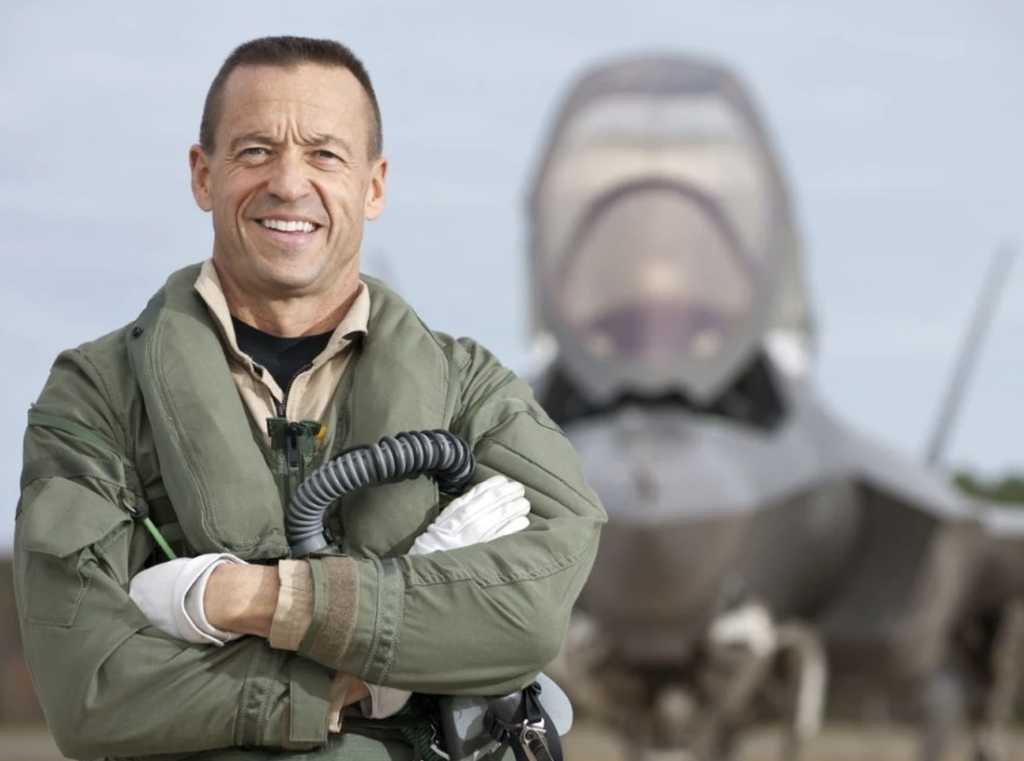
Legendary RCAF fighter pilot and test pilot Billie Flynn was asked in a recent podcast interview with popular aviation site The Merge if he had a magic wand, what would he do to help save the Royal Canadian Air Force.
During the interview, dubbed “Canada’s Air Force crisis,” Flynn did not pull any punches. A straight shooter, both in a jet cockpit or as an air force vet, he referred to a recent leaked report in the Globe & Mail. Commissioned by Canada’s Department of National Defence, the report assessed the country’s small and rapidly aging CF-18 Hornet fleet may not be able to meet its commitments.
Prepared by the Royal United Services Institute (RUSI), a well-respected British think-tank, it was funded by the Canadian Department of National Defence (DND) and classified as “Not for Public Release.”
Among its conclusions is the RCAF fighter fleet, entirely comprised of CF-18 Hornets — a mix of decades-old F/A-18A-B models and more recently acquired ex-Australian F/A-18A-Bs — “is not credible in a NATO context against many of the higher-end mission sets.”
The RCAF also has international obligations to fulfill to NORAD. In that role, just 36 of the RCAF’s CF-18s are equipped with contemporary-standard AESA (active electronically scanned array) radars.
The report’s author, Justin Bronk, cited additional concerns aside from aging equipment, asserting the RCAF fighter force is “suffering from low morale, high rates of departure among instructor pilots and a shortage of maintenance technicians, impairing its ability to meet defence obligations to allies.”
A complete and utter disaster. And they didn’t want you to know. They would rather fill your heads with climate change propaganda.
And by the way, that report comes on the heels of Canada’s formal US$74 billion decision to acquire 88 F-35As earlier this year, a process mired in politics for more than a decade, notably impacted by decisions taken by his highness, Prime Minister Justin Trudeau, who said before assuming office in 2015 that Canada would not buy the F-35.
Flynn would point out there are only 50 fighter pilots left to fly the remaining F-18s, which, at the end of their service, will have flown for 50 years.
That’s right, 50 years! An incredible record, for any fighter jet airframe.
Canada’s F-18s will undergo costly upgrades via a program known as the Hornet Extension Project (HEP), allowing the aircraft to operate in civil airspace out to 2032 and the switch to 5th-generation F-35s.
Ironically, as soon as the F-18s are fully upgraded, they will be moth-balled!