ST. JOHN’S, N.L. — Sheldon Murphy has been told that, from a very early age, he was obsessed with throwing around little plastic airplanes.
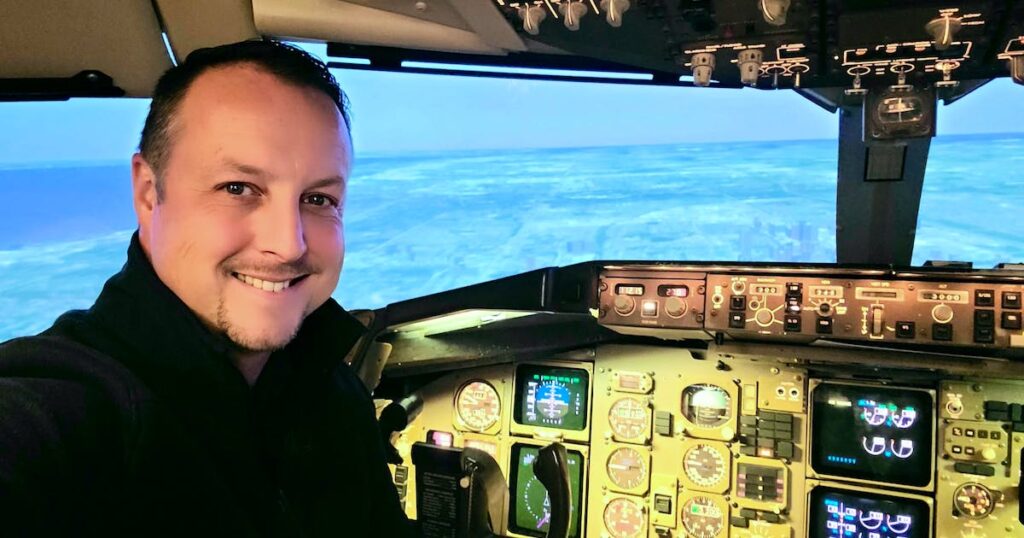
The Lewisporte native, now an Air Canada Boeing 767 captain and a flight training evaluator, doesn’t recall a specific time when he began reaching for the skies as a career.
In 1990, his family visited a relative in Florida who not only flew a Hercules C130 for the military, but took them up in it. He recalls being mesmerized by that experience and anything else that had to do with aviation as he got older.
It’s not surprising that when he turned 15 in 1994 he saved up enough money — $100 — from his newspaper carrier route to enroll in his first lesson in flying a real plane at Gander Flight Training.
When he graduated from high school a few years later, he took a year to work at a hardware store and save up enough to attend Gander Flight Training full-time in the fall of 1998.
Thirteen months later, he was an instructor at the training academy that now boasts having trained more than 3,000 pilots in its 30-year history.
He was soon off to his first gig as a commercial pilot, doing forest fire detection patrols in northern Ontario for Hicks and Lawrence, a company that has hired many of Gander Flight Training’s graduates.
When that job ended, there was a bit of a lull in the aviation industry and Murphy headed back to work as an instructor in Gander in 2004.
Three years later, his big break finally came when he was hired by Air Canada, a move that led him and his wife to move to Barrie, Ont., where they continue to live to this day.
Choosing the lifestyle of a pilot was an easy one for Murphy and one he’s glad he pursued.
“Air Canada has so many choices and options for pilots,” he explained. “You can choose to have a lifestyle career where you’re home and work the least amount of days each month, or you can choose to work the most amount of days a month and be gone a lot.”
Murphy has had a taste of all the piloting options available, from domestic passenger and transporter flights to international flights. The latter are his favourite.
“Places like Germany, Belgium, Greece, Italy, Spain — I love all these countries: the food, the people, the culture, the weather,” he said. “When I flew Air Canada Rouge for four years, we would spend three or four days in some of these places because we only had one or two flights a week.”
He’s been flying a 767 freighter since the COVID-19 pandemic struck, making deliveries mostly to South American destinations such as Lima, Peru, and Bogota, Colombia, as well as Mexico City.
He has flown to Asian countries such as Japan and China, and to Morocco in North Africa. Australia is on his bucket list and he hopes to get to fly a jet Down Under someday.
Global shortage
It takes a special sort of person to want to be a pilot, and Patrick White, the chief executive officer of Gander Flight Training, would like to see more of those people come forward, since there is a global shortage of pilots these days.
There are currently about 85 students learning to fly in Gander and, while the school is busy instructing them, White is also busy recruiting new students from all over the world.
“It’s not just about putting out an ad,” he said. “You have to go headhunting and do everything you can to bring people into your system, train them and put them in your operation.”
Gander Flight Training has trained people from such countries as India, Thailand, Turkey, Morocco, Colombia and, of course, Canada. The company has a long-standing agreement with Rangsit University in Bangkok to train their students to fly.
There are many other career options now available to the kind of people who make good pilots, explained White, and convincing them to choose a career in aviation isn’t always easy.
“We’re looking for somebody looking for an interesting career and likes to travel,” White said. “Flying an airplane itself is exciting and a dynamic activity, so we’re looking for people who want a little bit of adventure.”
Young people these days are used to easily adapting to new technology, he noted, adding that advances in aviation technology have made learning to fly easier.
With plenty of job opportunities around the world, becoming a pilot can be a rewarding career, White said .
“You can fly around world and the benefits and working conditions are pretty amazing these days in the aviation industry,” he said.

Willing to go anywhere
Steven Cobb of Paradise has turned to preparing for a career in aviation after trying his hand at being a college-trained automotive mechanic and a power line technician.
“There just weren’t many jobs with that kind of stuff and I knew there was a pilot shortage,” said the 27-year-old. “I was in between things and not getting any younger, so why wait?”
Cobb needs just a few more hours in the cockpit and to complete his multi-engine and instrument ratings before he graduates from Gander Flight Training. He hopes to achieve that by February, at the latest.
Becoming a pilot has been all he thought it would be, though there are aspects he never realized would be involved.
“A lot of people think you just learn about the aircraft and away you go, but there’s so much more,” he said. “Nobody told me when I told them I wanted to be a pilot that you also have to be a meteorologist and a mathematician. You have to be good at all that stuff.”
Those disciplines are employed when calculating crucial things like the proper weights and balances of the aircraft or factoring how atmospheric pressure affects air speeds.
“As long as you know what it is you have to apply to each situation, it’s not so bad,” said Cobb.
All that work has certainly not deterred Cobb, who is hoping to land a job in Newfoundland and Labrador or in Atlantic Canada, but won’t limit himself to flying close to home.
“I’m willing to go anywhere,” he said. “Being a pilot, you have to be willing to relocate wherever you want to go. The end goal would be to work with Air Canada to travel and see the world.
“All it takes is that first job and a bit of experience. Then you can pretty much go wherever you want.”
The right stuff
Murphy is grateful that he earned his wings at Gander Flight Training. It wasn’t just the quality instruction, but the environment in which he learned that helped him gain his piloting skills.
“Because of the weather and the rapidly changing weather there, you quickly learn your limitations in an airplane and your own limitations,” he explained. “You won’t frighten yourself very often before you start learning a lesson and say to yourself, ‘I better not go there again.’”
When he was a young pilot, rookies needed to amass more hours than they currently do to get hired. With the global shortage, it’s easier now for pilots with less experience to begin their careers.
Murphy’s advice to anyone contemplating a career in aviation is to do an introductory flight at a local flight training school to gauge their comfort level with flying, talk to someone who has worked in the field to learn about the lifestyle and get into it as soon as they can in order to make their way through the ranks more quickly.
“It’s a career you have to love,” he said, noting there is no room for someone who is half-hearted about becoming a pilot. “If you don’t love it, you can always just get a recreational permit, fly during the day and have a bit of fun.”